



Editor’s Note: This story is a multimedia special. You can listen above, read the text below, or watch the mini-documentary.
In December 1983, while folks exchanged sweaters and fruitcakes, Neil Young received a special gift from his label, Geffen Records: a lawsuit. Geffen was suing him for, of all things, not being himself.
The lawsuit alleged his recent albums were “unrepresentative” and “musically uncharacteristic,” and the label demanded $3.3 million from Young for the crime of not sounding like Neil Young.
Geffen, a hungry new label, had signed Young to boost its prestige. But when he delivered his first album, Trans, they got nervous. While Young’s ragged Les Paul guitar, “Old Black,” was still in the mix, it was buried under layers of synthesizers. Worse, his distinctive, fragile tenor had been replaced by a robot.
Geffen was right, it didn’t sound like Neil Young. But that was the point. Young wasn’t trying to sound like himself; he was trying to sound distorted with a device called a vocoder.
Long before Young used the vocoder to frustrate the executives at Geffen, it was used to foil the codebreakers of the Third Reich. In the 1940s, as the war in Europe became the world’s, FDR and Churchill needed to communicate securely across the Atlantic. Their standard radio-wave conversations were easily intercepted by a Nazi station in Norway, so Bell Telephone Laboratories developed a solution codenamed SIGSALY.
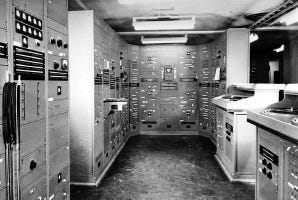
The system was massive and complex, involving synchronized vinyl and rooms of equipment. At its heart was the “voice encoder,” or vocoder. Invented by Bell engineer Homer Dudley, it converted the human voice into encrypted electronic signals. It was perfect for the war effort, but could it make music?
Bell Labs had actually dipped its toe in the musical waters in 1938, using a vocoder to record an old Irish folk tune, “Love’s Old Sweet Song.” It had an ethereal quality, but the sound remained a novelty until the mid-60s, when a young artist, Wendy Carlos, encountered the device at the New York World’s Fair.
Carlos began experimenting and later recalled that, “The first reactions were unanimous: everyone hated it!” Everyone, that is, except Stanley Kubrick. Fresh off 2001: A Space Odyssey, Kubrick heard Carlos’s vocoder treatment of Beethoven’s Ninth and recruited Carlos for the soundtrack of A Clockwork Orange. The vocoder was now an instrument, and it was soon adopted by genre-bending artists like Kraftwerk, Herbie Hancock, Afrika Bambaataa, and ELO.
By the late 90s, the device was so routine that when Cher released “Believe,” one of the producers explained away the AutoTune effect as just another vocoder trick.
But when Neil Young plugged in a vocoder, critics were baffled. Rolling Stone said it was “like seeing a satellite dish sitting outside of a log cabin.” It felt alien. But again, for Young, that was the point.
At the time, one of his sons, born with cerebral palsy, was struggling to communicate.
For Young, the vocoder wasn’t just a cool effect; it was a father trying to inhabit his child’s world, inviting listeners into that disorienting, painful distance.
The philosopher of technology Albert Borgmann distinguishes between a “device” and a “focal thing.” A “device” is a tool that delivers a result but hides the work behind it. A “focal thing” demands your skill and attention, creating meaning around it. A modern heating system is a device that gives warmth. A hearth, by contrast, is a focal thing. It demands that you chop wood, build the fire, and tend the flame. It requires skill and attention to gather the household around a center of meaning.
It’s easy to treat technology as just a device, a shortcut to make life easier. Neil Young did the opposite. He didn’t use the vocoder to hide his effort; he used it to struggle, to center his life around his son’s condition. He didn’t use it to make singing simpler, he used it to make communication more meaningful.
Geffen eventually settled out of court and apologized, while Young continued his legendary career. But Trans left us with an enduring lesson: Technology is often a device that reduces effort, but it can also be a focal point that deepens connection.
The difference isn’t in the machine. It’s in what you’re doing with it.


